
Coffee from Yemen to Istanbul: the story of the Ottoman coffee trade
The story of how coffee reached Constantinople (Ottoman Istanbul) is a combination of trade and politics. Coffee did not appear in the capital of the Ottoman Empire overnight. It gradually made its way there by caravan and sea routes from Yemen and Egypt.
From the Sufi monasteries of Yemen to the port of Mocha
By the 15th century, coffee was already popular among Sufi brotherhoods in Yemen. Small Sufi communities became one of the first environments where coffee evolved from a local drink into an important part of the religious, social, and commercial life that would later develop within the Ottoman world.
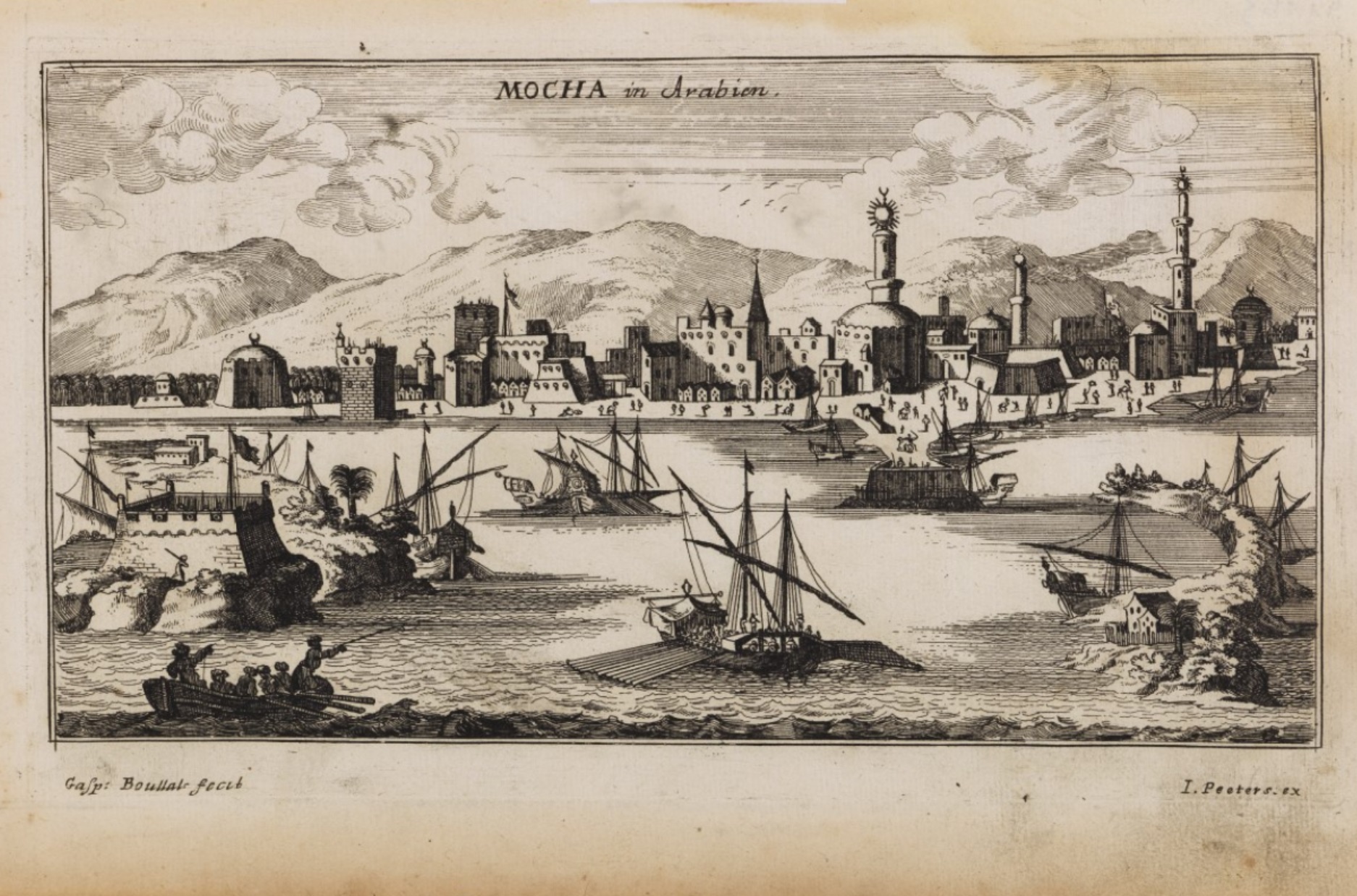
The port of Mocha, Yemen, c. 1690. Engraving by Gaspar Bouttats

Sufis often held night prayers (tahajjud), spent long hours reading the Quran, and practiced dhikr - the repeated recitation of prayers and the names of God. These spiritual practices could last for several hours, sometimes almost until dawn.
A drink made from the seeds of the coffee plant, which had reached Yemen from Ethiopia, helped them feel less tired during fasting, stay awake during night prayers, and maintain mental clarity. At first, Sufi sheikhs recommended the drink to their students. Over time, the custom of drinking coffee spread between Sufi lodges (ribats) and cities.
One of the main centers from which coffee spread was the mountainous region around the city of Sana'a. Local Muslim merchants (tujjār) bought coffee from farmers and transported it by caravans of camels and mules to the port of Mocha (al-Mukhā).
The port of Mocha - the main center of the coffee trade
The port of Mocha was a major storage and logistics center where coffee beans were dried, sorted, and packed into large bales made of jute or other coarse fabric.
Located on the maritime trade route connecting India with Egypt, the port became the main center for the export of Yemeni coffee. Indian, Egyptian, and Arab merchants arrived there. Along with sacks of coffee, they carried the custom of drinking it back to their own countries.
The port also had its own financial system. Indian banias effectively controlled a significant part of its financial operations, including lending, brokerage services, and contracts. Their services were widely used not only by Arab merchants but also by European traders and companies.
How coffee was transported from Yemen to Cairo
In Mocha, coffee was loaded onto dhows, baghlahs, and similar sailing vessels. The ships were mainly owned by private traders, usually Arab or other Muslim merchants.
The vessels sailed north along the Red Sea coast toward Suez or, less frequently, to other ports such as Jeddah and Yanbu on the Red Sea coast of present-day Saudi Arabia.
Because the Red Sea was also the route to the Muslim holy cities of Mecca and Medina, carrying both pilgrims and goods, the Ottoman Empire sought to maintain tight control over it, and its fleet patrolled the main routes. As a result, the risk of encountering pirates there was considerably lower than in the Mediterranean.
In Suez, the cargo was unloaded and transported by camel caravans to Cairo.
Today, thanks to the Suez Canal, cargo ships can pass directly between the Mediterranean and the Red Sea. At that time, however, the two seas were separated by land.
The desert crossing from Suez to Cairo was one of the most dangerous parts of the journey. A caravan could face attacks by nomadic tribes or Bedouins, as well as sandstorms. That is why merchants rarely risked traveling alone. Instead, they moved in large caravans protected by hired guards.
Cairo was one of the largest trading centers of the Ottoman Empire after Constantinople. For many years, Cairo merchants effectively controlled the wholesale coffee trade.
Imported coffee was taxed there, new deals were made, and the cargo was repacked. Then, with new caravans and, in most cases, new owners, it continued to Alexandria, where the coffee was loaded onto large Mediterranean ships.
How coffee was transported from Egypt to Istanbul
The journey from Alexandria to Constantinople could take anywhere from several weeks to more than a month, depending on the season, winds, and weather conditions.
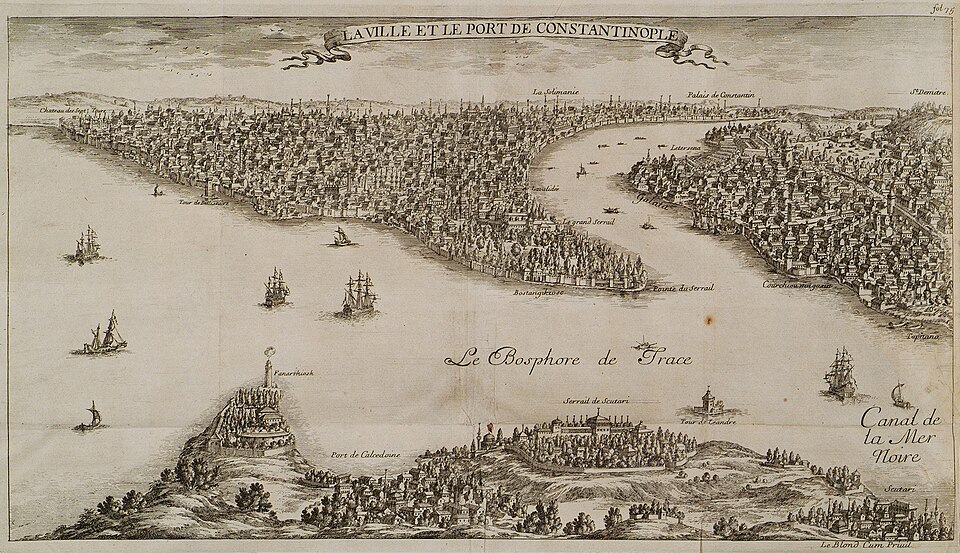
The city and port of Constantinople, 1680. Illustration by Guillaume-Joseph Grelot.

Ships crossed the eastern Mediterranean and the Aegean Sea, passed through the Dardanelles, and entered the Sea of Marmara before reaching the Golden Horn, the inlet connected to the Bosphorus that divides the European side of Istanbul.
This route could hardly be called safe either.
Merchant ships could encounter the Knights of Malta, Tuscan and Spanish corsairs, or various Mediterranean pirate fleets. They attacked trading vessels throughout the eastern Mediterranean, particularly near Cyprus, Rhodes, the southern coast of Anatolia, and Crete.
Later, as coffee became an increasingly important commodity for the imperial capital, shipments could travel as part of protected convoys or under the protection of Ottoman military galleys.
At the port, the cargo was met by customs officials. Once the required duties had been paid, the goods could be unloaded — and this was where coffee finally completed its long journey to Constantinople.
From there, it was purchased by merchants, court suppliers, coffeehouse owners, and representatives of the Sultan's court.
Overall, from the harvesting of coffee in Yemen to its arrival at the port of Constantinople, the journey could take approximately two to four months. Storms, caravan delays, or bureaucratic procedures could make it considerably longer.
Coffee taxation
There was also a geopolitical aspect to the story, as we would probably call it today.
In 1517, Sultan Selim I conquered the Mamluk Sultanate. Egypt, the Hejaz, Mecca, and Medina came under Ottoman rule. Several decades later, the Ottomans also established control over significant parts of Yemen.
As a result, practically the entire coffee trade route came under the authority of a single empire.
The highland coffee-growing regions of Yemen and the port of Mocha, the Red Sea, Suez, the overland route to Cairo and Alexandria, the eastern Mediterranean, and the Bosphorus and Dardanelles - all of them became different parts of the Ottoman imperial system.
Control of the "coffee route" by a single empire reduced some of the risks involved in transporting coffee, but it certainly did not eliminate taxes.
The reason was that the Ottoman Empire was not a single unified economic space. Each province had its own budget and administration, and one of the administration's responsibilities was collecting taxes.
The Ottomans levied customs duties (gümrük resmi) at virtually every major port. Different charges were collected at major trading hubs: port fees, warehouse fees, and customs duties.
In Mocha there were one set of taxes. In Suez, where the same sacks of coffee arrived on their journey from Mocha toward Alexandria, there were others - charged on exactly the same goods. And the process continued along the entire route all the way to Constantinople, modern-day Istanbul.
All the risks of transportation and the numerous taxes were eventually reflected in the price paid by the final consumer.
And that is why coffee in the Ottoman Empire was far from a cheap commodity.