
The stranger in the coffeehouse
Constantinople, 1571. In an Ottoman coffeehouse, Mehmed learns the truth about the Battle of Lepanto before the news has spread through the city. What begins as fear soon turns into an ambitious idea: to use the changing balance of power to open a new coffee trade route to Venice.
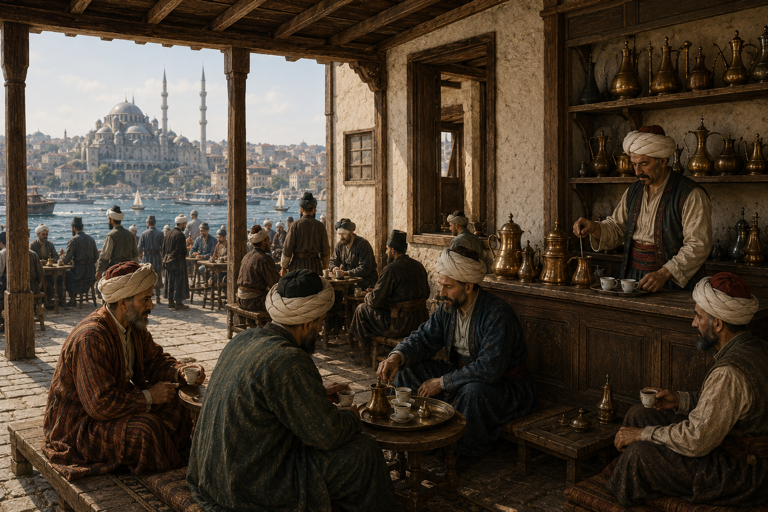
Only an hour had passed, yet three empty fincans already stood on the table before Mehmed, and he was about to order a fourth.
To say the man was nervous would be putting it mildly. However hard Mehmed tried to keep himself under control and his emotions in check, the tension radiating from him was so palpable that some of the patrons of Hakem's Coffeehouse had begun paying him far more attention than he would have liked, whispering quietly among themselves whenever they glanced his way.
A few minutes later, a small fincan of thick, freshly brewed coffee and a glass of cold water were placed before him on a copper tray. At the bottom of the cup, the dark coffee grounds had already begun to settle.
"From Yemen," Mehmed thought for some reason.
Once, when he had still been a boy, he had traveled with his father to Mocha, the Yemeni port on the shores of the Red Sea from which ships carried coffee, spices, cotton, and countless Persian and Indian goods throughout the empire.
The air around the cargo docks in the coffee quarter of the port had been so thoroughly saturated with the aroma of raw coffee beans that not even the gentle breeze blowing in from the Red Sea could disperse it.
Perhaps the rich aroma rising from the freshly brewed coffee had awakened memories buried deep in his subconscious.
Taking his first sip, Mehmed once again caught, from the corner of his eye, the steady gaze of the solitary man seated in the corner.
The stranger slowly sipped his coffee, scarcely taking part in the conversations around him. At first glance he appeared to notice no one, yet his eyes wandered over the room again and again, lingering on Mehmed each time.
"One of the Grand Vizier's men," Mehmed realized.
A chill immediately ran through him.
By tomorrow, someone would surely report his presence to the authorities. And if anyone happened to recognize him, there would be no escaping trouble.
Such men were a common sight in Constantinople's coffeehouses. Alongside ordinary townsfolk, merchants, and minor officials, the Sultan's informants quietly listened to every conversation.
From the Sultan’s point of view, coffeehouses were dangerous places. They were where politics, war, rumors, and the latest news were discussed openly. To the court, they were potential breeding grounds for sedition, and therefore they were watched closely.
"Damn it…" Mehmed thought a bead of sweat escaped from beneath his turban, rolled slowly down his forehead, and dropped into his fincan.
"Pull yourself together... or you're going to attract exactly the kind of attention you don't need."
But how could he possibly remain calm when he knew something that only a handful of people in all of Constantinople knew? Yes, rumors had already begun to circulate through the bazaars and coffeehouses - but they were only rumors. Mehmed knew the truth. And that knowledge weighed heavily upon him, filling him with fear and refusing to let his mind rest.
"Damn that Greek, Constantinos!" Mehmed cursed to himself for what felt like the hundredth time. It was Constantinos who had quietly told him that the Sultan's fleet had been utterly destroyed at Lepanto.
"Why had he arrived from Alexandria now, of all times? Why had he crossed paths with the shattered remnants of the Ottoman fleet? And why, in God’s name, had he chosen to tell me?"
Mehmed understood perfectly well why Constantinos had taken such satisfaction in sharing the news. It was no secret that Greeks and Turks had little love for one another. Yet they lived within the same empire, and coexistence was simply a fact of life. There was also another reason why Mehmed and Constantinos managed to get along. Money. Profit had a remarkable way of making men overlook differences that would otherwise divide them. That was why Mehmed knew exactly what Constantinos had been doing in Egypt.
The Greek was a well-known merchant who shipped Yemeni coffee from Alexandria to Constantinople. Through years of trade, he had built strong relationships with Egyptian merchants, who in turn maintained close ties with Arab coffee traders in Mocha. Nearly all the coffee consumed in Constantinople followed that route. For years Mehmed had tried to win Constantinos's trust, hoping for an introduction to one of those influential Egyptian merchants. They financed purchases, organized transportation, and frequently extended credit for coffee shipments. Without access to them, entering the coffee trade on any meaningful scale was virtually impossible. But Constantinos understood that as well. He never invited Mehmed to Alexandria. He never introduced him to his Egyptian partners.
"If I give the Turk direct access to them, Constantinos had once joked, why would they ever need me again?"
The thought suddenly struck Mehmed with such force that he nearly knocked over his empty fincan.
"What if… What if I bypass the Egyptians altogether? What if I establish direct trade with the Venetians?"
If Constantinos insisted on keeping him away from Egypt's coffee merchants, perhaps there was another path. Wars came and went. Trade endured. Coffee was still a novelty in Venice. Few merchants dealt in it, which meant the market remained almost untouched. Someone had to be first. Someone had to establish the routes, the contacts, and the reputation before everyone else realized the opportunity. And perhaps… Perhaps the destruction of the Sultan’s fleet could become an unexpected advantage. The Venetians would almost certainly receive greater commercial privileges. More of them would arrive in Constantinople. More merchants meant more opportunities to build relationships. Perhaps this disaster could become the beginning of something far more profitable. The very thought made Mehmed break into an even heavier sweat. To welcome the defeat of the Sultan's fleet - even privately - bordered on treason. A very dangerous kind of treason. Yet the profits… If everything could be arranged quickly enough, the profits might be enormous.
"I need to walk," he muttered to himself. He always thought more clearly while walking. Stepping out of Hakem's Coffeehouse, he barely noticed the busy streets around him.
"Direct coffee shipments to the Christians…" The idea refused to leave his mind.
"Why didn't I think of this sooner?"
By then he had completely forgotten about the defeated fleet. He had forgotten Constantinos. He had forgotten the Grand Vizier's informant sitting quietly in the corner of the coffeehouse. His mind had already moved elsewhere. It was calculating. Estimating costs. Imagining profits. The numbers it produced pleased him more and more with every passing moment.
"Coffee from Alexandria... through me... to Venice… Control the route. Become the man through whom every sack of coffee bound for Venice must pass." The vision was almost intoxicating.
Despite the Ottoman defeat at Lepanto in 1571, Venice and the Ottoman Empire remained major trading partners. In the decades that followed, coffee would gradually become one of the most valuable commodities of Eastern trade. But that is another story.