
From Ancient Greek to Ottoman Turkish: the etymology of the word Fincan
The word fincan is much older than coffee culture itself. Its ancestors originally referred to boards, dishes, and vessels. Only centuries later did the word become associated with the small cup used for coffee.
I have already written about where the name fincan comes from. In this article, I would like to explore this question in more detail.
Fincan is not originally a Turkish word, but the result of a long chain of borrowings between languages. However, as is often the case, the earliest part of this chain is not entirely certain or firmly established.
Turkish etymological sources trace fincan back to the Arabic فنجان (finjān), meaning "bowl" or "cup", and the Arabic form to the Persian پنگان (pingān), which had a similar meaning.
From Classical Persian to Ottoman Turkish
In Classical Persian, there was a word پنگان (pingān), meaning a vessel, bowl, or dish. Interestingly, this word existed long before coffee culture emerged, so it did not originally refer specifically to a "coffee cup".
And this is an important point: the word fincan is older than the fincan itself as a coffee-drinking vessel.
From Persian, the word entered Arabic and became finjān (فنجان). The change from p to f occurred because Classical Arabic did not have the /p/ phoneme. The Persian origin of the Arabic form is also recorded in lexicographical sources.
The Arabic word finjān already means a "cup" or "small vessel", and it is still used in Arabic today to refer to a cup, particularly a coffee cup.
From Arabic, the word then entered Ottoman Turkish:
Arabic finjān to Ottoman Turkish fincan (فنجان)
Here, the sound j /dʒ/ is represented by the Turkish letter c, which in modern Turkish is pronounced approximately like the English j in job.
In other words, fincan is pronounced roughly "fin-jan", not "fin-kan".
Ottoman dictionaries also record the form filcān. A written occurrence of fincān / filcān appears in Meninski's dictionary from 1680, although the word may have been in use much earlier.
But where did the Persian word Pingān come from?
Some modern etymological sources suggest an even longer chain of borrowings:
Ancient Greek πίναξ (pínax) to Aramaic pīnkā to Syriac pīnḵā to Persian pingān to Arabic finjān to Ottoman Turkish fincan
However, the Syriac-to-Persian stage is considered uncertain or possible rather than firmly established.
Let's take a closer look at what each of these words originally meant.
Ancient Greek πίναξ - Pínax
In Ancient Greek, the basic meaning of pínax was "board" or "flat plank".
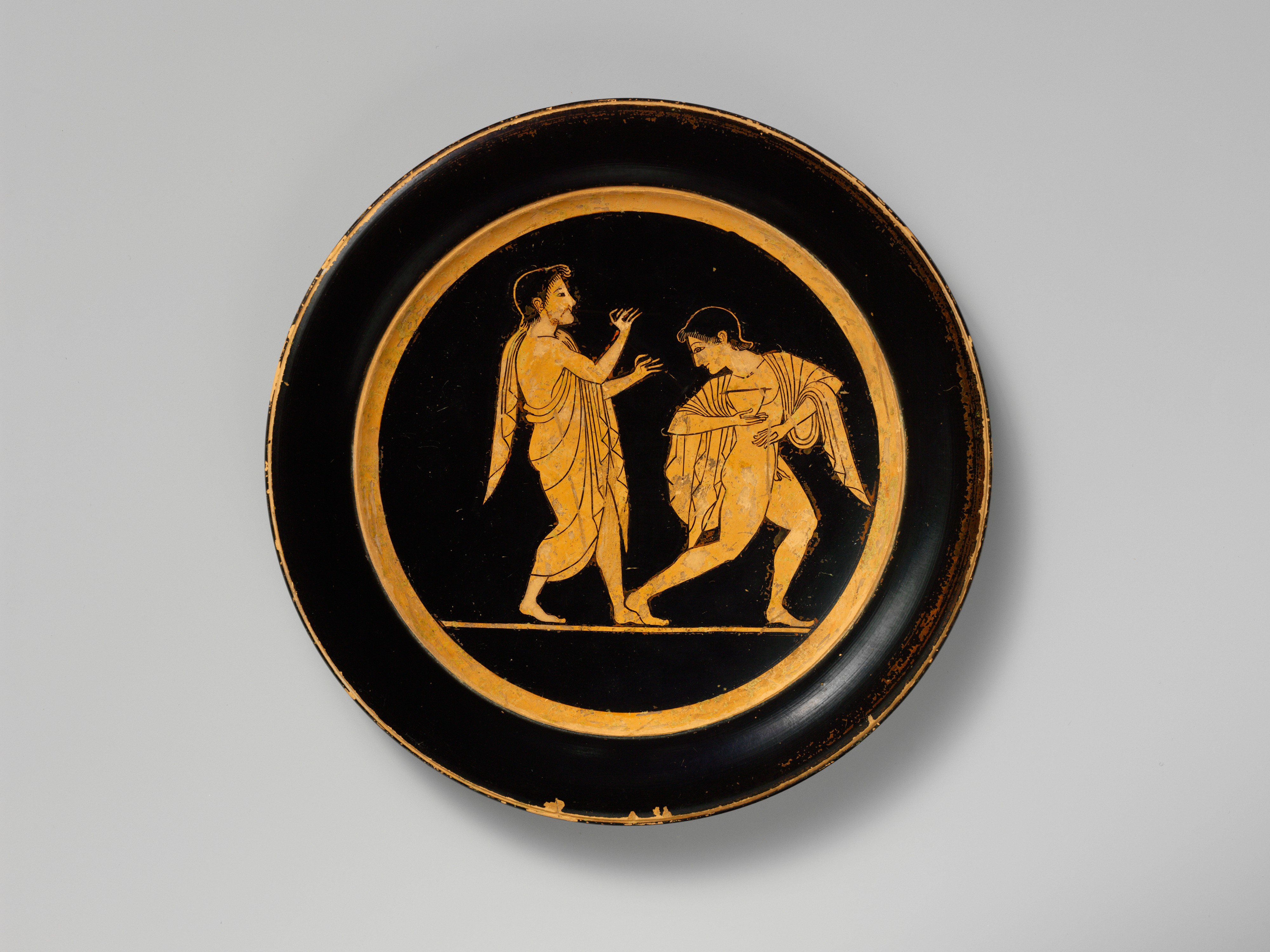 Ancient Greek terracotta plate, ca. 510 BCE, attributed to Paseas. The Metropolitan Museum of Art, New York.
The LSJ Greek-English Lexicon gives meanings such as board and plank, but the word was also used for other objects with flat surfaces, including a tablet, plate, or platter.
So we have a possible development in meaning:
πίναξ to flat board to flat plate or platter
But there is an important detail: this was not yet a cup.
Aramaic Pīnkā
In Aramaic, the word was already used to refer to a dish or vessel.
We have a possible transition:
Greek pínax (plate/platter) to Aramaic pīnkā (dish)
Syriac Pīnḵā
Syriac is a variety of Aramaic, so the meaning remains close to dish, plate, or vessel.
In other words, we are still talking about tableware, not specifically a coffee cup.
At the same time, researchers consider the Syriac link between Aramaic and Persian to be less certain, as reflected in some etymological references.
Persian Pingān
In Persian, the meaning moves toward a bowl, dish, or vessel.
The object is now closer to what we might imagine today as a cup or bowl. However, calling the early Persian pingān a coffee cup would not be entirely accurate, since the word existed before coffee became part of everyday culture.
Arabic Finjān - فنجان
Here we finally arrive at the familiar modern meaning.
Modern Arabic dictionaries define finjān as a small vessel or cup, often made of porcelain or similar materials, used for drinking coffee, tea, and other beverages.
In other words:
finjān = cup
And very often:
finjān al-qahwa = cup of coffee
Interestingly, Arabic lexicographical sources explicitly describe فنجان (finjān) as an Arabicized form of بنكان (binkān), supporting its origin from an older, non-Arabic word.