
History of Coffee: From Ethiopian Forests to the Legend of the Pope's Coffee Ban
Coffee has come a long way before becoming the drink we know today. Its story begins in Ethiopia, continues through Yemen and the Ottoman Empire, and eventually reaches Europe. Along the way, coffee was surrounded by legends, religious concerns, bans, and even political suspicion. Coffeehouses became places to meet, talk, exchange news, and do business. So, let's take a look at how a simple coffee berry managed to travel across continents and become part of everyday life.
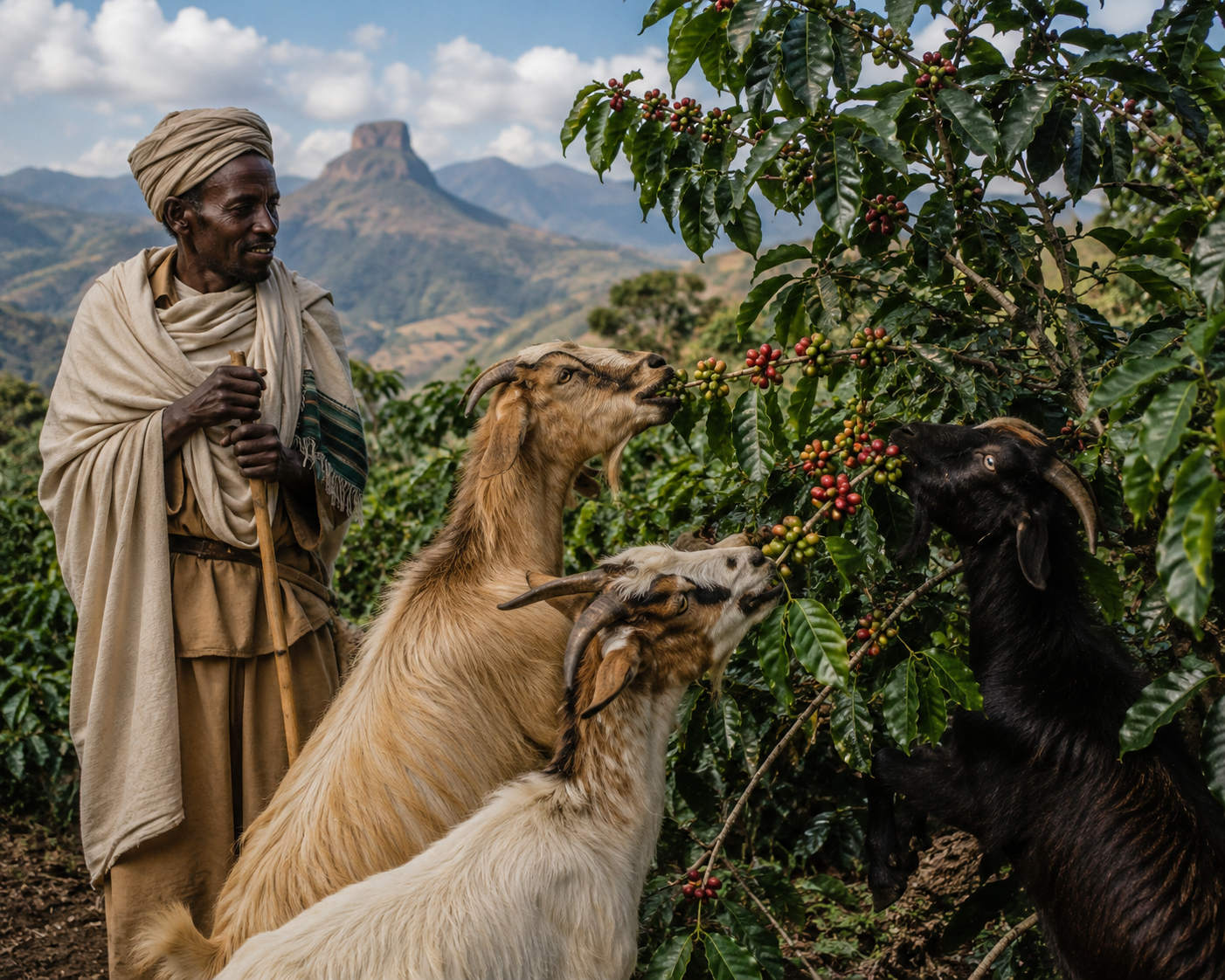
Evening was falling. The sun was preparing to disappear beyond the horizon of one of the countless plains of the Ethiopian Highlands. At last, a light cool breeze began to blow, and Kaldi was already thinking about wrapping himself in his rough but fairly light cloak. Everything was as usual for this time of year. Just as it had been ten, twenty, and forty years ago, when his grandfather, his father's father, had herded goats here.
The only thing that bothered Kaldi in this familiar scene from his childhood was the behavior of his goats. It was not the first time he had noticed that they became unusually lively after eating red berries from unfamiliar bushes that had appeared in the area several years earlier.
"Perhaps I should tell the monks about it after all," Kaldi decided, and quickly began preparing to head home. In the village, the monks' verdict was unanimous - the devil! An enthusiastic group of volunteers immediately gathered to destroy this manifestation of evil and headed toward the mysterious bushes with their no less mysterious berries. Under the monks' supervision, all the berries were picked and thrown into a fire specially lit for the purpose.
Immediately, to everyone's surprise, a soft and wonderful aroma of freshly roasted coffee began to spread through the air. The remaining berries were quickly pulled from the fire, placed into a pot that seemed to have appeared from nowhere, and covered with water for further storage. Nobody mentioned the devil anymore.
And so the first coffee drink was born.
Unfortunately, this is only one beautiful legend among dozens of legends about the origin of coffee. No one knows for certain how or when people first began preparing and drinking coffee. Most researchers agree that coffee began its journey in a region located in the southwest of modern-day Ethiopia, with the rather telling name of Kaffa.
At first, no one brewed coffee in the form we are used to seeing in our coffee shops today. People ate coffee berries or made infusions from their pulp. It was only after coffee reached Yemen, neighboring Ethiopia, around the 15th century thanks to Arab merchants that monks in local Sufi monasteries began roasting and grinding the beans and brewing a drink much closer to modern coffee, using it to fight sleep during long hours of religious services.
It was there, in Yemen, that the world's first coffee plantations also appeared. The Arabian Peninsula is also associated with another version of the origin of the word "coffee." The Arabic word qahwa (قهوة), which was originally used for wine or other intoxicating drinks, later came to refer to coffee. Through the Ottoman Turkish kahve and Italian caffè, the word eventually developed into the English coffee.
The further history of coffee takes us to Constantinople (modern-day Istanbul), where the first shop selling coffee, "Kiva Han", appeared in 1475.
According to the Ottoman historian İbrahim Peçevi, in 1554 two Syrian merchants - Hakem from Aleppo and Şems from Damascus - opened the first known coffeehouses in the Tahtakale district of Constantinople. Today, it is a historic commercial quarter in the Fatih district, not far from the Egyptian Bazaar and the Golden Horn, attracting tourists with its wholesale markets and traditional atmosphere dating back to Ottoman times.
Coffeehouses in the Ottoman Empire of that period were something like men's clubs - meeting places where men enjoyed their drinks while listening to music, playing chess or backgammon, gossiping (where would we be without that), hearing the latest news, or making business deals. Women and children were strictly forbidden from entering coffeehouses.
Generally speaking, if we sum it up, coffeehouses in an era without the Internet or social media served as places where all kinds of information were gathered and spread. Because of this, coffee consumption was even banned several times and could be severely punished. While coffee reached the Ottoman Empire thanks to Arab merchants, it is generally believed that Venetian merchants brought it to Europe. Through them, coffee first arrived in Venice, where in 1645 the first European coffeehouse - a bottega del caffè - was opened (although according to other accounts, the first one opened in Livorno in 1632), and from there coffee began spreading throughout Christian Europe.
It began spreading - and found itself facing a ban from the Pope.
At the time, Christianity and the Ottoman Empire were engaged in a large-scale confrontation, and according to legend, the Pope feared that coffee could lead to what people today might call the cultural Islamization of the population. Read the real story: Pope Clement VIII and coffee: Did the Catholic Church really want to ban the Devil’s drink?
Fortunately, the ban, if it ever existed at all, did not last long. According to the legend, it was lifted around 1600, which helped coffee continue its rise in popularity throughout Europe.