
Coffee in Ottoman Constantinople: inside a Vizier's private chamber
A short story in the style of a historical novel about coffee-drinking traditions in the wealthy households of Ottoman Constantinople, where coffee was prepared with care, served in delicate fincans, and enjoyed as part of a refined daily ritual. Through the private chamber of a powerful vizier, the story explores the arrival of Yemeni coffee, the etiquette of Ottoman hospitality, and the quiet conversations that unfolded around a small copper cezve.
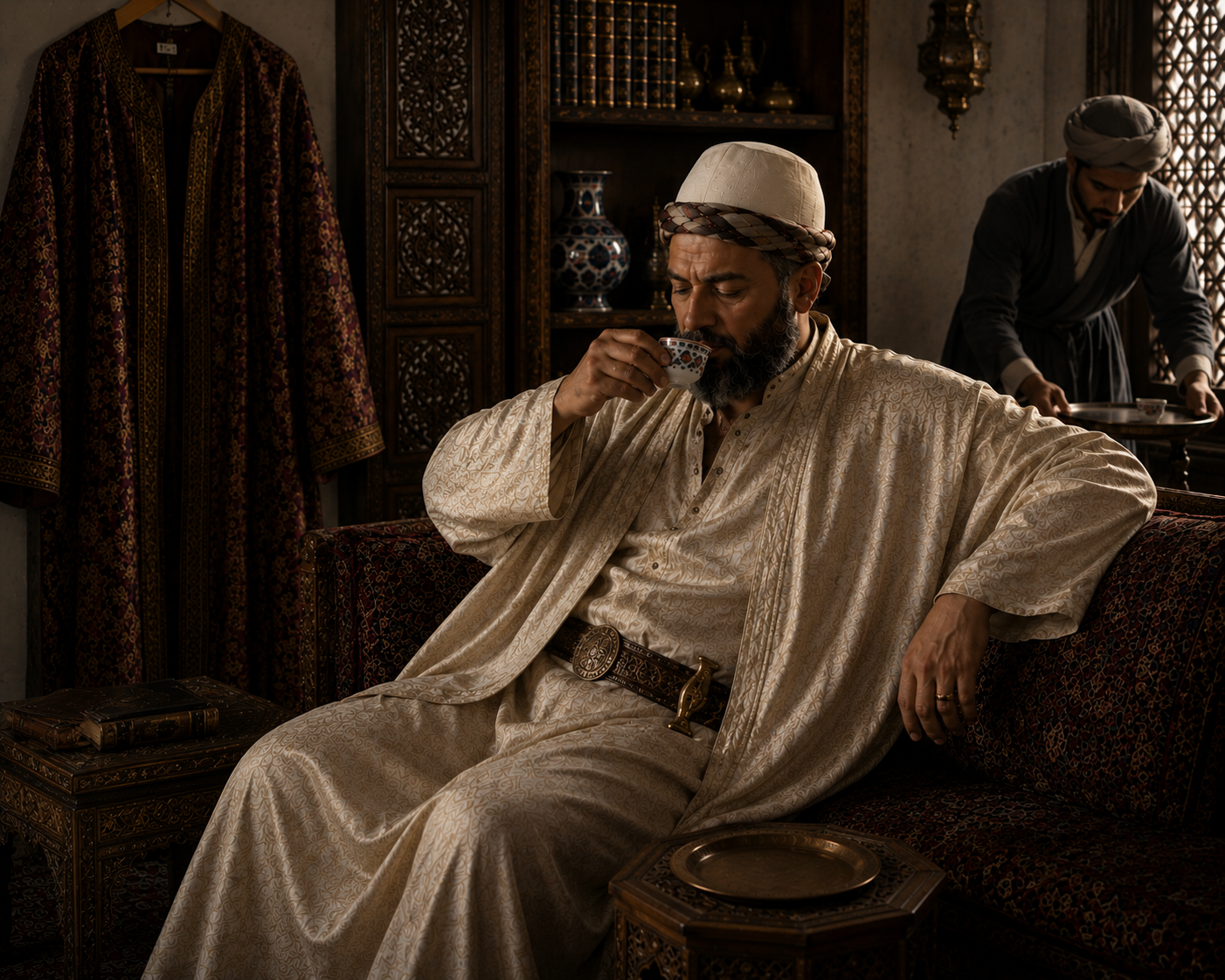
The heavy brocade kaftan was already hanging on a wooden hanger. In its place, the vizier had put on a light house robe of fine silk. His broad belt with its dagger lay nearby, while the large ceremonial turban he wore for official duties had been replaced by a simple white cap, around which a narrow strip of cloth had been loosely wound.
The coffee servant entered silently, like a shadow. He wore a dark blue kaftan of fine wool, fastened with a broad cream-colored sash. His snow-white turban was tied impeccably, and not a single fold of his clothing betrayed the slightest haste. In his hands he carried a heavy silver tray upon which stood a tiny fincan.
Step by step, he approached the vizier, inclined his head slightly, and with a smooth movement presented the cup. Not even the delicate porcelain walls made a sound, so assured were his movements. Once the fincan was in his master's hands, the coffee servant retreated just as silently toward the wall and quickly left the room, as though he had never been there.
The vizier especially enjoyed drinking coffee from this particular fincan, made of Chinese porcelain and presented to him as part of a set by merchants from Damascus in gratitude for his assistance in a delicate matter. He allowed himself this pleasure only when he was certain that no one would disturb him and he could devote himself entirely to his thoughts while savoring a cup of carefully selected coffee from Haraz.
This mountainous region west of Sana'a, the capital of the local sultanate in Yemen, had long been renowned as a place where some of the most highly prized Arabica coffee was grown. Thanks to its high elevation, cool climate, and terraced plantations, the local coffee was celebrated for its rich aroma and was considered among the finest exported through the port of Mocha to the Ottoman Empire.
The vizier had established a very good relationship with the kahveci başı, the Sultan's chief coffee maker. Thanks to regular gifts of a certain sum of money, the vizier continually received coffee from the Sultan's court.
The kahveci başı's responsibilities included purchasing coffee, personally supervising its roasting and grinding, and overseeing the preparation of the drink. He knew better than perhaps anyone else in the empire where to find the finest coffee and from whom to buy it. He also knew that poor-quality coffee - or simply coffee that failed to please the Sultan - could cost him his head.
The vizier was in no hurry. Holding the cup between his thumb, index finger, and middle finger, he took several small sips, as though assessing its aroma, and only then allowed himself to return to his thoughts.
Tomorrow morning, he would have to attend the Divan, where the Sultan would finally decide the question of war with the infidels.
But that was tomorrow.
Tonight, there was still time to enjoy the exquisite aroma of Yemeni coffee. And later, after the evening prayer, he would go to the harem, where a beautiful Circassian woman was already waiting for him - a gift from a bey he knew in Georgia.